
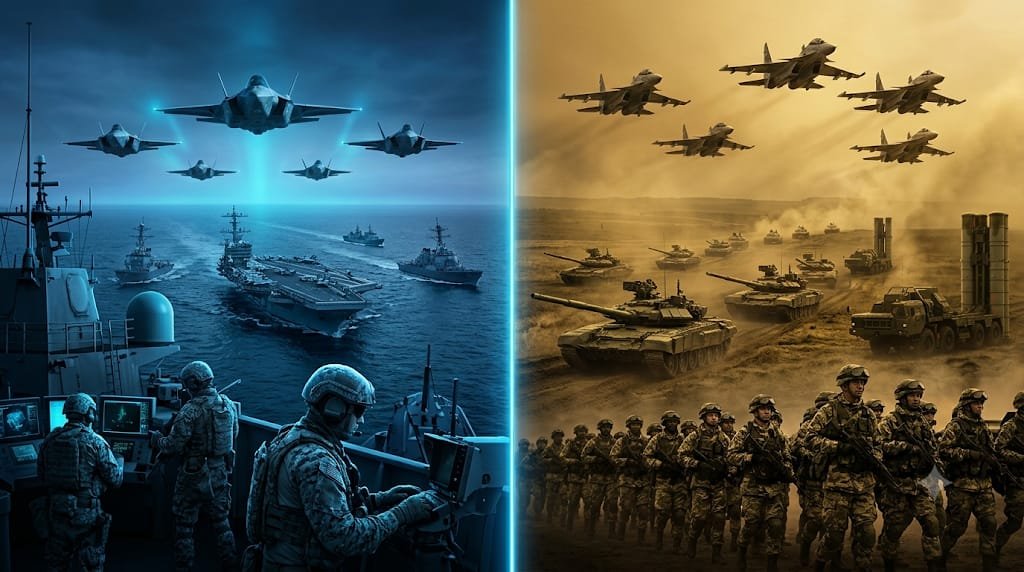
NATO vs BRICS Military Comparison: Soldiers, Helicopters, Bases & Firepower Compared
The debate over global military balance often pits the North Atlantic Treaty Organization (NATO) against the expanding BRICS bloc. While NATO functions as an official 32-nation defense alliance bound by mutual defense obligations, BRICS operates as an economic partnership without a collective military command.
Evaluating both groups purely by hardware data, personnel counts, and forward deployment bases reveals stark contrasts in how both power centers are structured.
nato vs brics military
Complete Military Head-to-Head: NATO vs. BRICS
| Military Metric | NATO (32 Allied Nations) | BRICS (Combined Member States) | Major Edge |
|---|---|---|---|
| Active Duty Soldiers | ~3.4 Million | ~7.0 Million | BRICS |
| Reserve Personnel | ~2.5 Million | ~5.3 Million | BRICS |
| Annual Defense Budget | ~$1.6 to $1.8 Trillion | ~$550 to $600 Billion | NATO |
| Total Military Aircraft | ~21,000 | ~17,600 | NATO |
| Fighter / Interceptor Jets | ~5,100+ | ~6,500+ | BRICS (Hull volume) |
| Total Helicopters | ~8,900 | ~5,800 | NATO |
| Dedicated Attack Helicopters | ~1,500 (AH-64 Apache, Tiger) | ~1,200 (Ka-52, Mi-28, Z-10) | NATO |
| Main Battle Tanks (MBTs) | ~11,500 | ~23,600+ | BRICS |
| Naval Fleet (Total Vessels) | ~2,100 | ~2,700 | BRICS (Coastal fleet) |
| Aircraft Carriers | 16+ (11 US Supercarriers) | 4 to 5 Operational Carriers | NATO |
| Nuclear Warheads | ~5,600 (US, UK, France) | ~6,200 (Russia, China, India) | BRICS |
| Foreign Military & Naval Bases | 800+ Worldwide | Under 35 Globally | NATO |
1. Standing Soldiers and Reserves: Manpower Advantage
nato vs brics military
- NATO: The alliance maintains approximately 3.4 million active-duty military personnel across its 32 member countries, backed by roughly 2.5 million reservists. The United States contributes roughly 1.3 million active troops, followed by Turkey with nearly 400,000, along with sizable contributions from Poland, France, Germany, and the United Kingdom.
- nato vs brics military
- BRICS: The bloc fields an overwhelming manpower base of 7.0 million active soldiers and more than 5.3 million reserve personnel. China’s People’s Liberation Army leads with over 2 million troops, followed by India’s 1.4 million standing force and Russia’s mobilized force exceeding 1.1 million, alongside personnel from Egypt, Iran, and Ethiopia.
- nato vs brics military
- The Reality: BRICS holds a clear 2:1 numerical manpower advantage, granting massive defensive depth for territorial operations.
- nato vs brics military
2. Air Strength: Fighter Jets, Helicopters, and Airframes
Fighter and Strike Jets
nato vs brics military
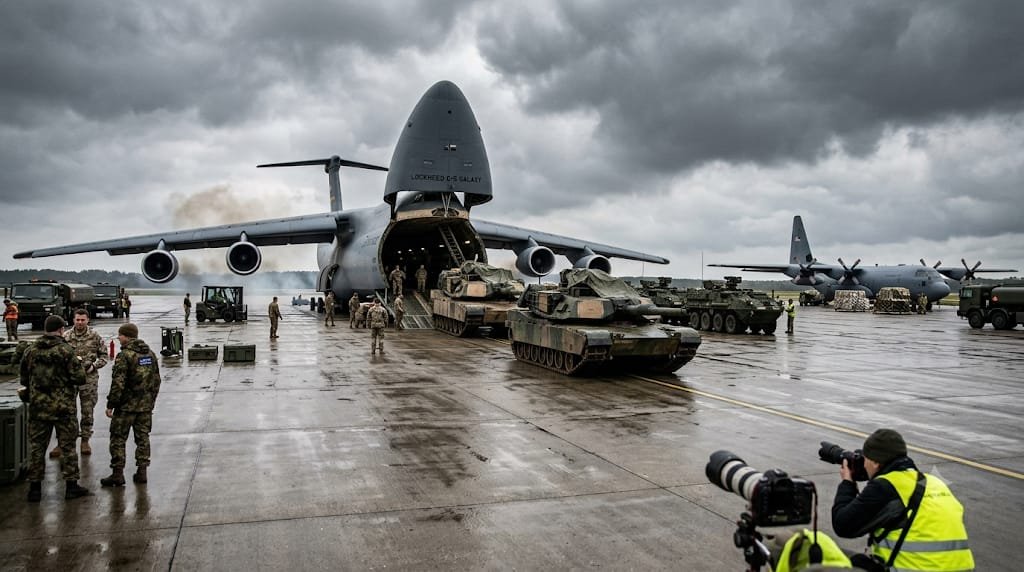
- NATO: Operates roughly 5,100 fighter and ground-attack jets. The primary tactical strength lies in 5th-generation stealth aircraft, notably hundreds of F-35 Lightning IIs and F-22 Raptors, supported by dedicated fleets of AWACS radar platforms and airborne refueling tankers.
- BRICS: Fields approximately 6,500 combat-capable jets, including China’s J-20 stealth fighters, multi-role J-16s, and Russia’s Su-35s and MiG-31 interceptors. While BRICS possesses high fighter volume, it maintains fewer combat-ready stealth airframes and specialized refueling tankers than NATO.
Total Helicopters and Attack Helos
nato vs brics military
- NATO Helicopter Fleet: Counts over 8,900 total helicopters, including roughly 1,500 dedicated attack helicopters such as the Boeing AH-64 Apache, Eurocopter Tiger, and modern heavy-lift transport choppers (CH-47 Chinook).
- BRICS Helicopter Fleet: Counts roughly 5,800 helicopters, with an estimated 1,200 specialized attack platforms like Russia’s Ka-52 Alligator and Mi-28 Havoc, alongside China’s Z-10 gunships and India’s LCH Prachand.
- The Reality: NATO leads significantly in total rotorcraft support, providing greater aerial battlefield mobility and ground-strike close support.
3. Sea Power: Aircraft Carriers vs. Coastal Fleets

- NATO at Sea: NATO fleets field roughly 2,100 total naval vessels, but dominate heavy oceanic combat through 16+ aircraft carriers and flat-top amphibious assault ships. The 11 US nuclear-powered supercarriers operate as floating air bases capable of projecting massive strike wings globally, escorted by layered Aegis air-defense guided missile cruisers and destroyers.
- BRICS at Sea: BRICS maintains a larger total hull count at roughly 2,700 vessels, but the roster consists primarily of corvettes, frigates, and light patrol missile boats designed for regional coastal protection. Only 4 to 5 operational carriers exist across the bloc (such as China’s Liaoning and Shandong, and India’s INS Vikramaditya and Vikrant).
- The Reality: NATO controls blue-water expeditionary naval power, whereas BRICS fields a dense littoral and coastal anti-access/area-denial (A2/AD) perimeter.
4. Global Footprint: Foreign Naval and Military Bases
nato vs brics military
Wars cannot be fought abroad without fueling hubs, airfields, and staging harbors:
- NATO Base Network (800+ Bases): The United States operates an infrastructure network of 750 to 800 military and naval installations across 80 countries, including major naval ports in Rota (Spain), Yokosuka (Japan), Bahrain, and Naples (Italy), alongside Ramstein Air Base in Germany. British and French overseas stations in Cyprus, Djibouti, and Pacific territories ensure uninterrupted operational logistics across every continent.
- BRICS Base Network (Under 35 Combined): BRICS nations have virtually zero foreign basing infrastructure:
- Russia: Operates the Tartus naval support facility and Hmeimim air base in Syria, with air stations across Central Asia (Tajikistan, Kyrgyzstan, Armenia).
- China: Operates one official overseas military support facility in Djibouti, with commercial deep-water access points under development across the Indian Ocean.
- India, Brazil, and Other Members: Maintain virtually no sovereign military bases outside their immediate home territories.
- The Reality: NATO has the logistics network to sustain long-distance wars anywhere in the world, while BRICS militaries are restricted mostly to fighting along their own regional borders.
Who Holds the Advantage?
- Where BRICS Wins: Raw troop numbers (7 million active), main battle tank volume (23,000+), and local defensive depth along Eurasian land borders.
- Where NATO Wins: Massive defense spending ($1.6T+), advanced 5th-generation aviation, attack helicopter inventories, blue-water carrier strike groups, and a 800+ base global logistics grid.
Because BRICS is a trade forum rather than a unified defense alliance with an Article 5 clause, these combined forces operate independently under separate national commands rather than a single coordinated military force.
for more info please click-NATO vs. BRICS: How Do Their Combined Military Powers Truly Compare?
Nice
Thankyou