
NATO vs. BRICS
The global balance of power is becoming increasingly complex as NATO and BRICS emerge as two of the most influential international groupings. While NATO is a formal military alliance led by the United States, BRICS is primarily an economic and political grouping that includes major powers such as China, India and Russia.
This raises an important question: If the military capabilities of BRICS countries were combined, could they truly challenge NATO?
The answer is not as simple as comparing troop numbers or defence budgets. Military power also depends on technology, logistics, naval reach, intelligence, nuclear capabilities, industrial capacity and, most importantly, the ability to operate together.
NATO Has a Major Advantage in Military Integration
NATO vs. BRICS
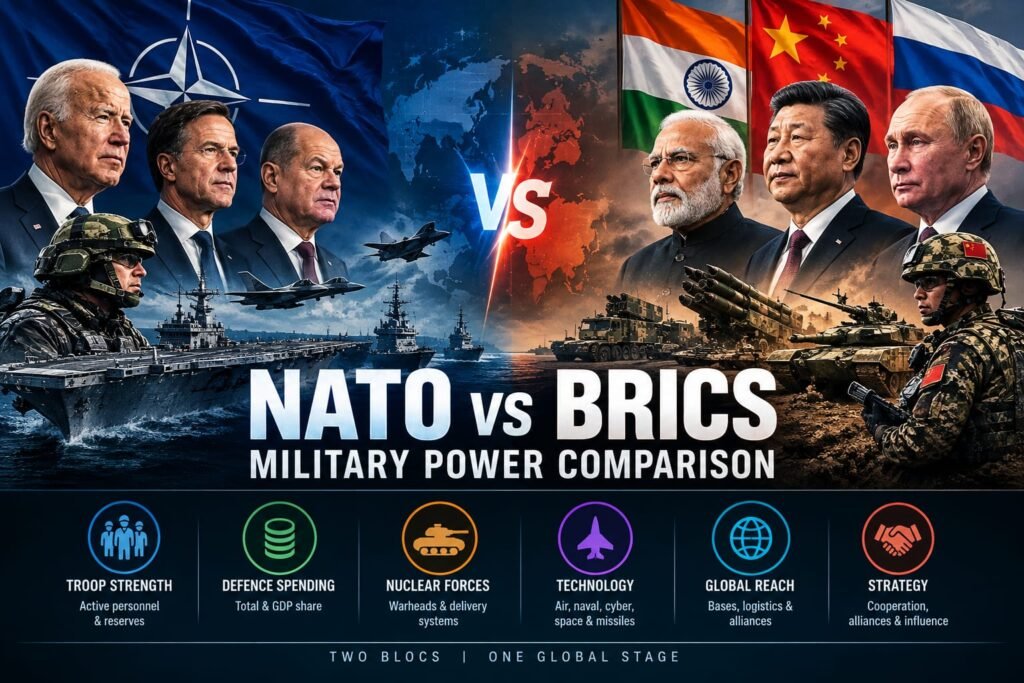
NATO’s biggest strength is not simply the size of its defence spending. It is the alliance’s decades of military integration.
In 2025, NATO members collectively spent around $1.58 trillion on their militaries, accounting for about 55% of global military expenditure, according to SIPRI. NATO also agreed in 2025 to move toward a new 5% of GDP defence and security spending target by 2035.
The United States gives NATO an enormous advantage in areas such as long-range air power, aircraft carriers, satellite intelligence, global logistics, precision weapons and military technology.
European NATO members also provide large land forces, advanced air forces, modern naval assets and an extensive industrial base.
Therefore, if the question is about a single integrated military command, NATO currently has the clearer advantage.
But BRICS Has Three Major Military Powers
NATO vs. BRICS
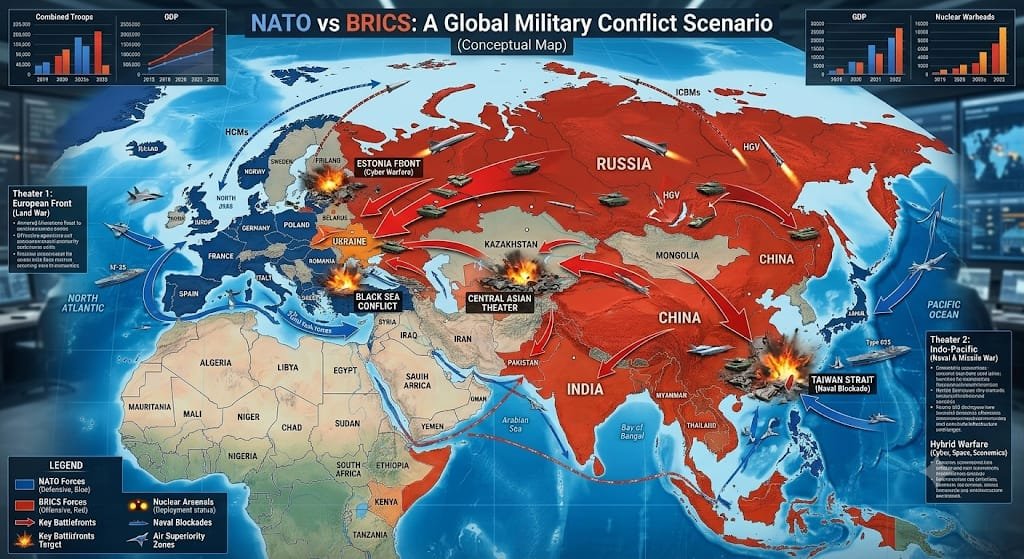
BRICS becomes much more interesting when China, Russia and India are examined together.
China provides enormous industrial capacity, a rapidly modernising military and one of the world’s largest defence budgets. Russia brings nuclear forces, missile technology, combat experience and major energy and defence-industrial capabilities. India contributes a huge manpower pool, a large standing military, a growing defence industry and a strategically important geographic position.
China, Russia and India are all among the world’s largest defence spenders.
This combination creates a potentially powerful strategic triangle.
China: Industrial and Technological Power
NATO vs. BRICS
China’s greatest military advantage is its industrial scale.
It has invested heavily in naval construction, missiles, drones, air defence, satellites and advanced military technology. Its geographic position also gives it enormous influence across the Indo-Pacific.
In a hypothetical BRICS-wide security framework, China could provide much of the manufacturing and technological capacity required for large-scale military production.
Russia: Missiles, Nuclear Forces and Combat Experience
NATO vs. BRICS
Russia brings a different set of strengths.
Its nuclear arsenal, missile forces, air-defence systems, submarines and military experience make it a major strategic power.
Russia’s experience from the Ukraine war has also demonstrated the importance of drones, electronic warfare, artillery, missiles and large-scale ammunition production in modern warfare.
India: Geography, Manpower and Strategic Reach
NATO vs. BRICS
India would add another critical dimension.
India has one of the world’s largest armed forces and occupies a strategically important position between the Indian Ocean, the Middle East and the Indo-Pacific.
Its geographic position could make India particularly important for maritime security and sea-lane protection.
India also has a growing domestic defence industry and an expanding missile, naval and aerospace capability.
What Happens If India, Russia and China Work Together?
NATO vs. BRICS
This is where the hypothetical scenario becomes strategically significant.
If India, Russia and China were ever able to establish deep military cooperation, they could potentially divide strategic responsibilities according to their strengths.
China could focus heavily on the Indo-Pacific and industrial production.
Russia could contribute strategic deterrence, missiles, air defence and military technology.
India could provide major manpower, Indian Ocean access and regional strategic depth.
Together, these capabilities could create a formidable force across Eurasia and the Indo-Pacific.
However, this scenario should not be confused with reality.
BRICS is not NATO.
BRICS does not currently have NATO-style collective-defence commitments, an integrated military command or a single operational structure.
In fact, major differences exist between India and China, including strategic competition along their disputed border. Recent reporting also highlights disagreements within BRICS over whether the grouping should become more explicitly focused on security and military cooperation.
The Real BRICS Strategy Would Probably Be Different
NATO vs. BRICS
Rather than creating a NATO-style military alliance, BRICS could become more influential through strategic coordination.
That could involve:
- greater defence-industrial cooperation
- joint military exercises
- intelligence and satellite cooperation
- coordination on maritime security
- alternative payment and financial systems
- energy cooperation
- increased use of domestic currencies in trade
- cooperation in drones, AI and cyber technology
- stronger defence supply chains
This would not necessarily mean creating a single BRICS army.
Instead, the objective could be to make the members more difficult to pressure individually.
Russia has recently argued that BRICS should develop practical cooperation in areas including technology, infrastructure, payments and investment rather than simply becoming another formal military bloc.
Where NATO Would Still Have the Edge
NATO vs. BRICS
Even if BRICS countries combined their military resources, NATO would retain several important advantages.
The first is military interoperability.
NATO countries have spent decades training and operating together.
The second is global logistics.
The United States has a unique ability to deploy forces, aircraft and naval assets across the world.
The third is advanced intelligence and surveillance.
Satellites, reconnaissance aircraft, communications networks and integrated command systems are critical in modern warfare.
The fourth is naval power.
NATO, particularly through the United States, possesses enormous blue-water naval capabilities and carrier aviation.
These factors mean that a simple comparison of tanks, soldiers or missiles would give an incomplete picture.
Where BRICS Could Be Extremely Difficult to Challenge
NATO vs. BRICS
BRICS would have its own major advantages.
Its geographic depth would be enormous.
China, Russia and India alone stretch across huge parts of Eurasia and the Indian Ocean region. A conflict involving these countries would therefore not resemble a limited regional war.
BRICS countries also possess enormous populations, industrial resources, energy supplies and manufacturing capacity.
Most importantly, Russia and China are nuclear powers, while India also possesses nuclear weapons.
This means that any direct NATO-BRICS confrontation would carry an extremely high nuclear escalation risk.
For this reason, the most realistic strategic competition would probably occur below the level of direct war.
Economic pressure, technology restrictions, cyber operations, sanctions, diplomatic influence, energy security and control of supply chains could become more important than traditional battlefield confrontation.
The Biggest Problem for BRICS: Internal Differences
NATO vs. BRICS
The biggest weakness of BRICS is not military hardware.
It is political cohesion.
India and China are strategic competitors. Russia has a very different relationship with the West from that of India and several other BRICS members.
BRICS also includes countries with different political systems, economic interests and foreign-policy priorities.
Recent reporting has highlighted disagreements over whether BRICS should remain primarily an economic and diplomatic platform or develop a stronger security role.
That makes a unified BRICS military command extremely difficult.
NATO vs. BRICS: Who Would Be Stronger?
NATO vs. BRICS
If we compare formal military integration, global power projection, logistics, advanced technology and command structure, NATO currently has the advantage.
If we compare geographic depth, population, industrial resources, nuclear deterrence and the combined potential of China, Russia and India, BRICS represents a very significant counterweight.
The more important question, therefore, is not simply “NATO vs BRICS: Who would win?”
The real question is whether BRICS can transform its enormous economic and strategic resources into effective cooperation without becoming divided by competing national interests.
If India, Russia and China could coordinate deeply while maintaining their individual strategic autonomy, the global balance of power could shift significantly toward a more multipolar system.
But if their political and strategic differences remain unresolved, NATO’s existing military integration will continue to give it a major advantage.
Conclusion
NATO and BRICS represent two very different models of international power.
NATO is a formal military alliance with established command structures and decades of operational cooperation.
BRICS is a broader political and economic grouping whose military potential is much greater than its current military integration.
China provides industrial and technological scale, Russia provides nuclear and missile capabilities, while India contributes manpower, geography and growing defence-industrial strength.
If these capabilities were ever coordinated at a much deeper level, BRICS could become one of the most powerful strategic groupings in the world.
However, the greatest obstacle is not a lack of military strength. It is the difficulty of making countries with different interests operate as a single strategic force.
For now, NATO has the stronger integrated military system, while BRICS represents a growing economic, demographic and strategic counterweight that could reshape the global balance of power over the coming decade.
1 thought on “NATO vs. BRICS: How Do Their Combined Military Powers Truly Compare?”