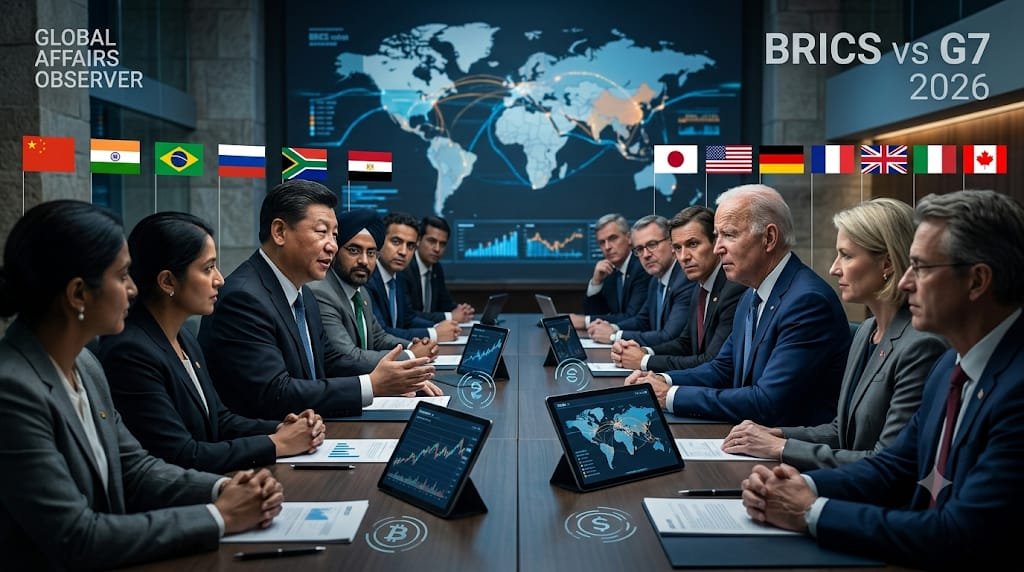
BRICS vs G7 2026
The global balance of economic power is becoming more competitive as BRICS expands its influence and the G7 tries to maintain its position at the center of the Western-led financial system.
The latest BRICS discussions in New Delhi have again put the rivalry between the two groups in focus, particularly around trade, currencies, financial cooperation and the growing role of emerging economies.
BRICS now includes a much larger group of countries than the original five-member bloc. Its members include major economies such as China and India, along with important energy producers and emerging markets.
That gives the group significant economic weight. But turning that weight into a unified challenge to the G7 is another matter.
BRICS Has the Numbers, But the G7 Has Financial Power

BRICS vs G7 2026
NATO vs BRICS: Military Strength, Weapons & Who Would Win?
BRICS represents a huge share of the world’s population and a large portion of global economic output, particularly when GDP is measured using purchasing power parity.
China and India are central to that strength. China is a manufacturing and export powerhouse, while India has become one of the world’s fastest-growing major economies.
The G7 has a different advantage.
The United States, Canada, Japan, Germany, France, Italy and the United Kingdom have highly developed financial systems, major technology companies and deep connections to global investment markets.
The US dollar also remains at the center of international finance.
That makes a simple BRICS-vs-G7 GDP comparison misleading. Economic size is important, but financial influence, technology and control over global institutions also matter.
BRICS Is Trying to Reduce Dollar Dependence
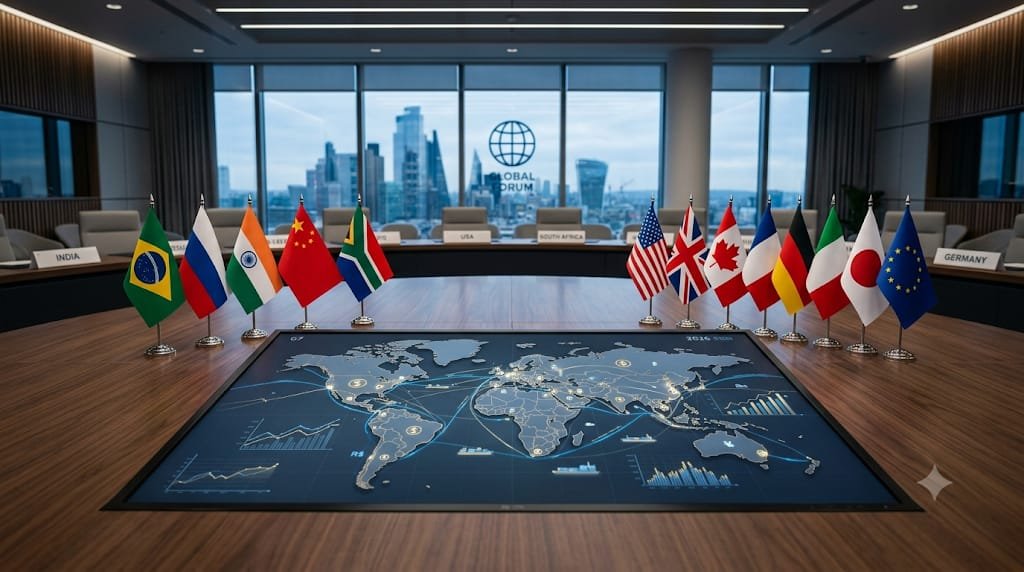
BRICS vs G7 2026
One of the biggest areas of competition is international payments.
BRICS countries have increasingly discussed using local currencies for trade and developing payment systems that can reduce dependence on traditional Western financial channels.
At the 2026 BRICS Summit in New Delhi, financial cooperation and greater use of local currencies remained important parts of the group’s agenda.
However, there is still a major difference between reducing dollar dependence and replacing the dollar.
BRICS has not created a single currency capable of competing directly with the US dollar. For now, the group’s approach is focused more on expanding alternatives than immediately replacing the existing system.
China and India Are the Key Players
BRICS vs G7 2026
The future strength of BRICS will depend heavily on China and India.
China gives the bloc enormous manufacturing capacity, trade networks and technological capabilities. India brings a large domestic market, a growing services sector and increasing importance in global supply chains.
But the relationship between the two countries is complicated.
Their strategic interests do not always align, and disagreements between major members could make it difficult for BRICS to operate with the same level of coordination seen within Western alliances.
That could become one of the biggest limitations on BRICS’ ambitions.
Can BRICS Actually Challenge the G7?
BRICS vs G7 2026
BRICS can certainly increase pressure on the Western economic system, but replacing the G7 is a much higher bar.
The bloc has advantages in population, natural resources, energy production and emerging-market growth. Its members also give it a wider geographical reach across Asia, the Middle East, Africa and Latin America.
The G7, however, continues to benefit from strong financial markets, advanced technology, established institutions and the global role of the US dollar.
The more realistic outcome may therefore be a more fragmented and multipolar global economy rather than a complete BRICS takeover.
Why Washington Is Watching BRICS
BRICS vs G7 2026
For the United States, the rise of BRICS could have consequences beyond the headline GDP figures.
If more countries increase trade in local currencies, develop alternative payment systems or coordinate their economic policies, US financial influence could face greater competition.
BRICS countries are also seeking a larger role in international institutions and global economic decision-making.
That does not mean the United States is about to lose its economic dominance. But it does mean Washington is facing a world where emerging economies have more options than they did in the past.
BRICS vs G7: What Comes Next?
The competition between BRICS and the G7 is unlikely to be decided by a single summit or one economic ranking.
BRICS has the size and resources to become a stronger force in global affairs. Its biggest challenge will be keeping a diverse group of countries aligned on major economic and geopolitical issues.
The G7 still has powerful advantages, particularly in finance, technology and the international role of the dollar.
For now, neither side has won the larger contest.
What is changing is the structure of the global economy itself. Instead of one dominant economic center, the world is moving toward a system in which the United States and its allies face stronger competition from China, India and other emerging powers.
That shift could make BRICS vs G7 one of the most important economic and geopolitical stories to watch through the rest of 2026 and beyond.
PLEASE ALSO READ-BRICS Currency vs US Dollar: What Happens to Global Trade if Dollar Loses Dominance?
1 thought on “BRICS vs G7 2026: Can BRICS Challenge the West’s Economic Power?”