
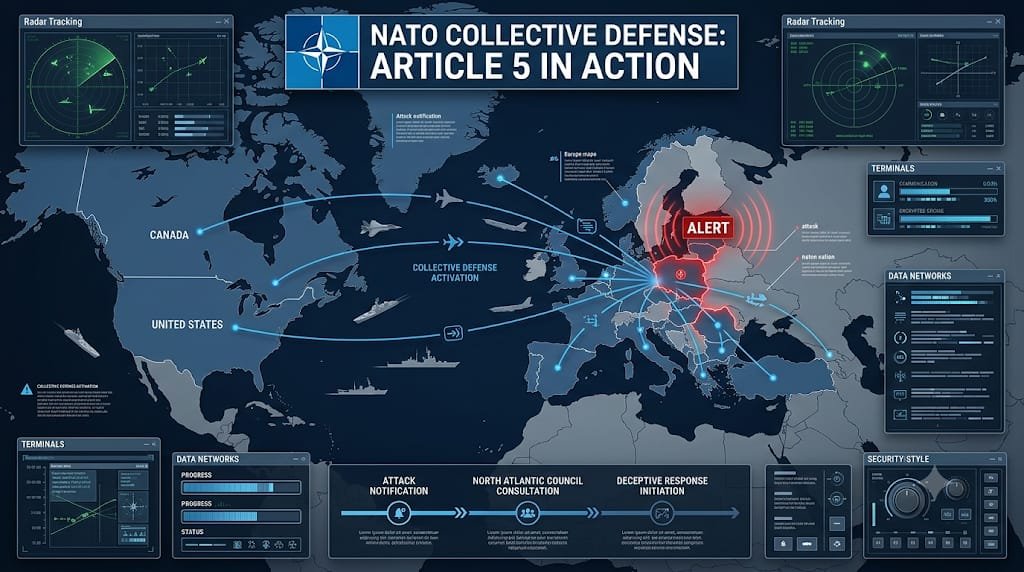
NATO Article 5 Activation
NATO Article 5 is activated when a NATO member suffers an armed attack that is covered by the treaty, and the attacked country requests or agrees to collective action. It does not mean that every NATO country automatically declares war or immediately sends troops.
When Can NATO Article 5 Be Activated?

Article 5 is NATO’s collective-defence clause. It says that an armed attack against one NATO member is considered an attack against all members.
However, there is no automatic “war button.” NATO says two key conditions must be met:
- A NATO member must have suffered an armed attack covered by the treaty.
- The attacked member must request or consent to collective action under Article 5.
The North Atlantic Council, NATO’s main political decision-making body, would then meet to assess the situation and coordinate the Alliance’s response.
What Could Trigger Article 5?
The most straightforward example would be a major military attack on NATO territory.
For example, if a NATO country were invaded or subjected to a significant armed attack, the Alliance could determine that Article 5 applies.
But not every incident automatically triggers Article 5. NATO members must assess whether the event qualifies as an “armed attack,” and the treaty also has geographic limits under Article 6.
Does Article 5 Mean the US Must Send Troops?
Not necessarily.
This is one of the biggest misunderstandings about Article 5.
Each NATO member must assist the attacked ally, but the treaty allows each country to decide what action it considers necessary. That assistance can include military force, but it could also involve intelligence, air defence, logistical support, or other measures. National constitutional requirements can also affect how a country provides assistance.
So, Article 5 means collective defence—not an automatic identical military response from every NATO country.
Has NATO Ever Used Article 5?
Yes, but only once.
NATO invoked Article 5 following the September 11, 2001 terrorist attacks against the United States. It was the first and remains the only time NATO has formally invoked Article 5.
What Would Happen After Article 5 Is Activated?
The immediate priority would be coordination.
NATO would work with the attacked member to determine what assistance is needed. Individual allies would then decide and coordinate the actions they will take to restore and maintain the security of the North Atlantic area.
That could mean military deployments—but it does not automatically mean that every NATO member enters the same war in exactly the same way.
NATO Article 5 could be activated after a qualifying armed attack against a NATO member, with the attacked country requesting or consenting to collective action.
The important point is simple: Article 5 creates a collective defence obligation, but it does not automatically force every NATO country to declare war or send troops.
2 thoughts on “NATO Article 5 Activation: When Can It Be Activated and What Happens Next?”