
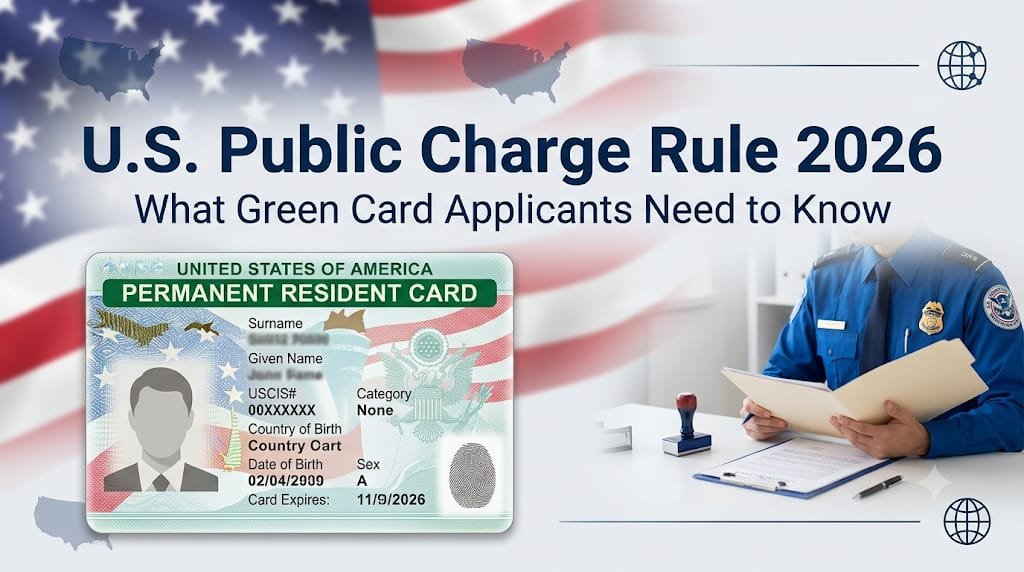
New U.S. Public Charge Rule
The U.S. Public Charge Rule takes effect September 18, 2026. Learn what the new rule means for green card applicants, public benefits and immigration.
A major change to the U.S. immigration system is set to take effect on September 18, 2026, and it could affect how some green card applicants are evaluated.
The U.S. Department of Homeland Security (DHS) has finalized a rule that rescinds the 2022 public charge regulations and restores a broader, more discretionary approach to determining whether certain immigrants are likely to become a public charge.
For green card applicants, the biggest change is that immigration officers will have greater flexibility to consider an applicant’s overall financial and personal circumstances, including the use of certain means-tested public benefits.
What Is the U.S. Public Charge Rule?
The public charge rule is part of U.S. immigration law that allows the government to determine whether certain people seeking admission to the United States or adjustment to lawful permanent resident status are likely to become dependent on government resources.
The new rule does not create a completely new immigration requirement. Instead, DHS is changing how the existing public-charge ground of inadmissibility will be applied.
According to DHS, the new approach is intended to restore broader officer discretion and allow public-charge decisions to be made on a case-by-case basis.
When Does the New Public Charge Rule Start?
U.S. Public Charge Rule
The final rule becomes effective on September 18, 2026.
It applies to:
- Applications for admission made on or after September 18, 2026
- Adjustment-of-status applications that are postmarked or electronically submitted on or after September 18, 2026
DHS has also specified that benefits received before September 18, 2026 will be considered under the rules that applied before the new rule took effect.
This means the filing date can be particularly important for people preparing an adjustment-of-status application.
What Is Changing for Green Card Applicants?
U.S. Public Charge Rule
Under the 2022 regulations, immigration officers operated under a more specific framework that limited which public benefits could be considered in a public-charge determination.
The 2026 rule removes many of those restrictions.
DHS says officers will now be able to consider relevant facts and circumstances on an individualized, case-by-case basis.
The government is also removing the detailed regulatory definition of who is “likely at any time to become a public charge.”
Instead, officers will have broader discretion to evaluate the totality of the circumstances.
That could make the financial circumstances of an applicant more important during the green card process.
Could Government Benefits Affect a Green Card Application?
Potentially, yes.
U.S. Public Charge Rule
Under the new framework, DHS will no longer limit consideration of public benefits to only the narrow categories that were emphasized under the 2022 rule.
The final rule allows consideration of means-tested public benefits received on or after September 18, 2026.
However, receiving a public benefit does not automatically mean that a green card application will be denied.
The public-charge determination is intended to be individualized and based on the applicant’s overall circumstances.
This distinction is important because headlines about the new rule may make it sound as though using any government program automatically disqualifies an immigrant. That is not how the rule is written.
trump-2026-midterm-election-strategy
What Factors Could Immigration Officers Consider?
New U.S. Public Charge Rule
The new approach gives officers broader discretion to consider relevant facts surrounding an applicant’s circumstances.
Depending on the case, this can include factors such as:
- Age
- Health
- Family circumstances
- Financial resources
- Income
- Education and skills
- Employment prospects
- Use of certain means-tested public benefits
- Other circumstances relevant to whether the person is likely to become a public charge
The final rule specifically emphasizes a totality-of-the-circumstances approach rather than a rigid formula.
That means two applicants receiving the same type of benefit could potentially receive different assessments depending on their broader circumstances.
Does Using Medicaid or Food Assistance Automatically Mean a Green Card Will Be Denied?
No.
New U.S. Public Charge Rule
This is one of the most important points applicants should understand.
The new rule expands the range of information that may be considered, but it does not establish an automatic rule saying that anyone who receives a particular benefit will be denied a green card.
Instead, immigration officers are expected to make an individualized determination.
The government says the purpose of the change is to give officers greater flexibility to determine whether an applicant is likely to become a public charge based on all relevant circumstances.
What About Family Members Receiving Benefits?
New U.S. Public Charge Rule
The public-charge ground applies to the person who is subject to the immigration determination, not to U.S. citizens.
Therefore, applicants should not assume that a family member’s participation in a government program automatically means the applicant will be denied a green card.
However, because the new rule gives officers broader discretion to consider relevant circumstances, applicants should be careful when evaluating their individual situation.
What Is a Public Charge Bond?
New U.S. Public Charge Rule
A public charge bond is a financial mechanism available under U.S. immigration law in certain circumstances.
Under the new rule, DHS is also changing the regulations governing public charge bonds.
If a public charge bond is required and accepted, the government can impose conditions on that bond.
The final rule states that a public charge bond submitted on or after September 18, 2026 can be considered breached if the person receives a means-tested public benefit while the bond remains in effect or violates another condition of the bond.
Importantly, applicants cannot simply submit a public charge bond on their own in advance to avoid the public-charge determination. The bond process is governed by USCIS and applies when the government determines that the requirements for a bond are met.
Who Is Exempt From the Public Charge Ground?
Not every immigration applicant is subject to the public-charge ground of inadmissibility.
U.S. immigration law contains exemptions and special categories.
Certain humanitarian immigrants and other categories may be exempt from the public-charge ground.
Therefore, an applicant should not assume that the new rule applies to every person applying for a green card.
The exact immigration category matters.
What Should Green Card Applicants Do Before September 18?
New U.S. Public Charge Rule
People who are preparing a green card or adjustment-of-status application should carefully review their situation before filing.
Here are some practical steps:
- Check Your Filing Date
If your application is subject to the public-charge ground, the September 18 effective date is important.
Applications postmarked or electronically submitted on or after September 18, 2026 can be subject to the new framework.
- Keep Financial Documents Organized
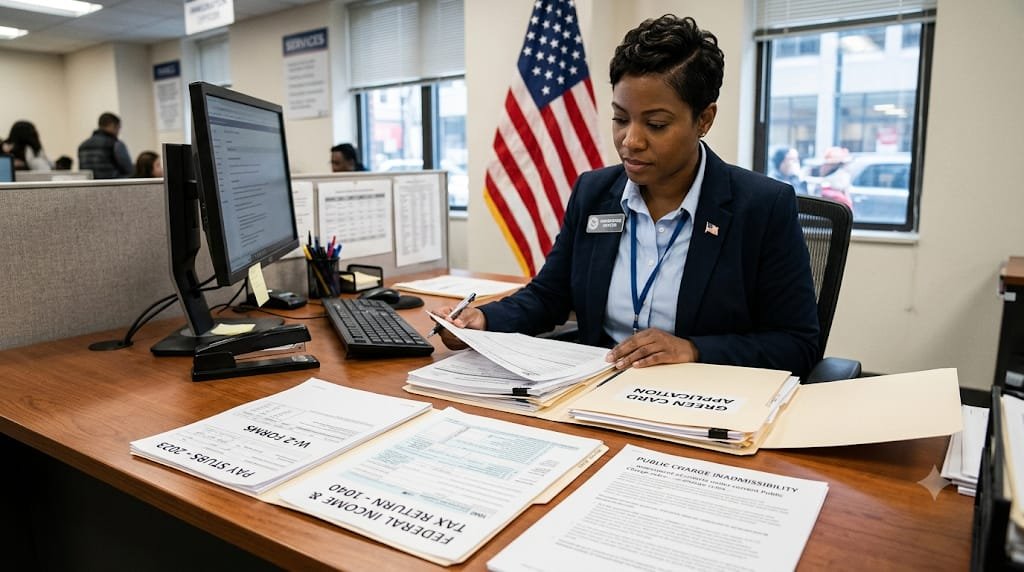
Applicants should maintain documents that clearly show their financial situation.
These may include:
- Employment records
- Pay statements
- Tax documents
- Bank statements
- Proof of assets
- Evidence of education or professional qualifications
- Proof of health insurance, when relevant
- Other documents showing financial stability
The exact documents required can vary depending on the immigration category and individual case.
- Understand the Benefits You Have Received
Applicants should know which public benefits they or their household members have received and when they received them.
The timing of benefits can matter because DHS has established different treatment for benefits received before and after September 18, 2026.
- Do Not Assume That Every Benefit Makes You Ineligible
A common misunderstanding is that receiving government assistance automatically leads to a green card denial.
The new rule does not establish such an automatic system.
Instead, officers are expected to consider the overall circumstances of the applicant.
- Consider Getting Professional Immigration Advice
Because the new framework gives immigration officers broader discretion, people with complicated financial, family or immigration histories may want to speak with a qualified U.S. immigration attorney or accredited representative.
This is especially important for applicants who have received means-tested benefits or who are concerned about their ability to demonstrate financial self-sufficiency.
Why Is the U.S. Government Changing the Rule?
New U.S. Public Charge Rule
DHS says the 2022 public-charge regulations were too restrictive and did not provide officers with enough flexibility to make accurate determinations.
The new rule removes many of those restrictions and restores what DHS describes as a broader, individualized assessment.
The government says the change is intended to ensure that immigration officers can consider all relevant circumstances when determining whether an applicant is likely to become a public charge.
Critics of the policy, however, have raised concerns that the broader discretion could create uncertainty for immigrant families and discourage eligible people from using public programs.
What This Means for Indian Green Card Applicants
New U.S. Public Charge Rule
The change is also important for Indian nationals who are pursuing U.S. permanent residency.
Many Indian applicants are in employment-based immigration categories and may have strong employment and income histories. However, whether the public-charge rule applies and how it affects an individual case depends on the person’s specific immigration category and circumstances.
Applicants should therefore avoid relying solely on general information circulating online.
The same rule can have very different practical implications depending on whether a person is applying through employment, family sponsorship or another immigration pathway.
Key Takeaways
New U.S. Public Charge Rule
The new U.S. public charge rule takes effect on September 18, 2026.
The most important points are:
- DHS is rescinding the 2022 public-charge regulations.
- The new rule gives immigration officers broader discretion.
- Officers can consider a wider range of means-tested public benefits received on or after September 18.
- Public benefits do not automatically result in green card denial.
- Officers will evaluate the applicant’s overall circumstances.
- The new framework applies to certain applications for admission and adjustment of status.
- Public-charge bond rules are also being revised.
- Applicants should carefully review their immigration category and financial circumstances before filing.
Final Thoughts
New U.S. Public Charge Rule
The September 18, 2026 public charge rule represents a significant shift in how the U.S. government evaluates financial self-sufficiency in certain immigration cases.
The biggest change is not simply the list of benefits that may be considered. It is the broader discretion given to immigration officers to evaluate an applicant’s complete circumstances.
New U.S. Public Charge Rule
For green card applicants, preparation will therefore be increasingly important. Keeping financial records organized, understanding the benefits received, checking eligibility for the public-charge exemption and getting professional advice when necessary can help applicants better understand their position under the new rules.
Important: U.S. immigration rules can be complex and may change because of new guidance or court decisions. This article is for general informational purposes and should not be considered legal advice. Applicants with individual immigration questions should consult a qualified U.S. immigration professional.
1 thought on “New U.S. Public Charge Rule Starts September 18, 2026: What Green Card Applicants Need to Know”