
High-Yield Savings Accounts vs. Index Funds: Where to Park Emergency Cash Today
When you build an emergency fund, one question quickly comes up: Where should you keep the money?
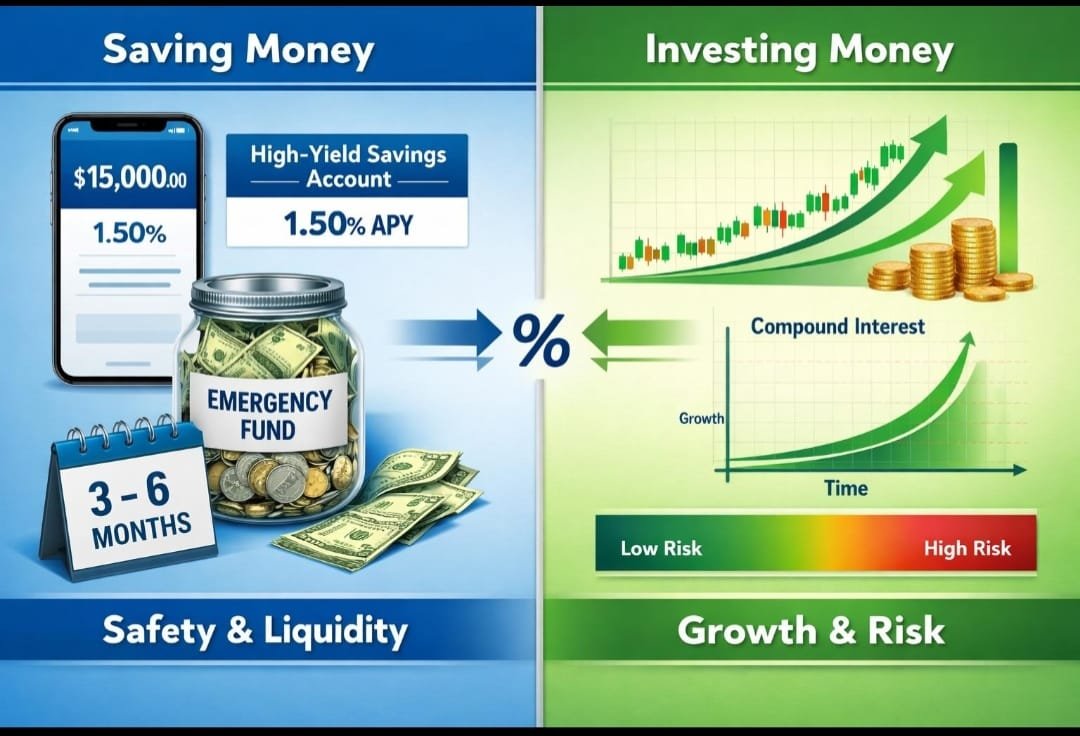
A high-yield savings account can provide interest while keeping your money relatively accessible. An index fund, meanwhile, can offer much greater long-term growth potential—but its value can fall when the stock market declines.
That creates an important distinction for Americans trying to manage their finances in 2026: emergency money and investment money generally have different jobs.
If you may need the money soon, protecting access to your cash can be more important than chasing higher returns. If you are investing for retirement or another long-term goal, accepting market fluctuations may make more sense.
So, should your emergency cash go into a high-yield savings account or an index fund?
The Short Answer
High-Yield Savings Accounts vs. Index Funds
For most people, an emergency fund is better suited to a high-yield savings account than a stock-market index fund.
The reason is simple: an emergency can happen at exactly the wrong time for the stock market.
Imagine losing your job during a market downturn. If your emergency fund is invested in stocks and the market has fallen 20%, you could be forced to sell investments at a loss to pay rent, a mortgage, medical bills, or other essential expenses.
A high-yield savings account generally provides easier access to cash without exposing your emergency fund to stock-market price fluctuations.
Index funds can still play an important role in your financial plan—but they are generally better suited to money you do not expect to need in the near future.
What Is a High-Yield Savings Account?

High-Yield Savings Accounts vs. Index Funds
A high-yield savings account, often called a HYSA, is a savings account that typically pays a higher interest rate than a traditional savings account.
The account is designed primarily for saving rather than investing.
Depending on the bank and account, you may be able to transfer money electronically to another account when you need it. Interest rates can change over time, so today’s APY is not necessarily the rate you will receive indefinitely.
One major advantage is that deposits at an FDIC-insured bank are generally protected up to applicable FDIC limits. The standard FDIC insurance limit is $250,000 per depositor, per insured bank, for each ownership category.
That protection is fundamentally different from what you receive when investing in stocks or stock-based funds.
What Is an Index Fund?
High-Yield Savings Accounts vs. Index Funds
An index fund is a mutual fund or exchange-traded fund designed to track a particular market index.
For example, some index funds track the S&P 500, while others track broader U.S. or international markets.
Instead of trying to select individual stocks, an index fund generally gives investors exposure to a collection of securities that make up its underlying index.
Index funds can be useful for long-term investors because they provide diversification and can have relatively low costs.
However, they are still investments.
The value of an index fund can rise or fall, and you can lose money—especially over shorter periods. The SEC’s Investor.gov notes that investments such as securities and mutual funds are not federally insured against losses in market value.
High-Yield Savings Accounts vs. Index Funds
New Tax Cuts and Policy Changes in 2026
High-Yield Savings Accounts vs. Index Funds
The biggest difference is the purpose of the money
- Feature| High-Yield Savings Account| Index Fund
- Primary purpose| Saving and preserving cash| Long-term investing
- Market risk| Generally no stock-market risk| Yes
- Potential return| Interest/APY| Potential capital appreciation and dividends
- Value fluctuations| Generally stable account balance| Can rise or fall
- Emergency-fund suitability| Generally high| Generally low
- Liquidity| Generally easy to access| Can be sold, but value may be down
- FDIC insurance| Available at eligible FDIC-insured banks| No FDIC insurance for investment losses
- Best suited for| Short-term needs and emergencies| Long-term financial goals
The SEC specifically describes savings accounts as a suitable place for emergency funds and short-term needs, while investments are generally better suited to longer-term goals.
Why an Emergency Fund Should Be Different From Your Investments
High-Yield Savings Accounts vs. Index Funds
An emergency fund is not designed to make you rich.
Its job is to protect you when something unexpected happens.
You might need emergency cash because of:
- A sudden job loss
- An unexpected medical bill
- A major car repair
- Emergency home repairs
- A temporary loss of income
- A family emergency
- An urgent travel expense
These expenses do not wait for the stock market to recover.
That’s why accessibility and stability are important characteristics of emergency savings.
Investor.gov notes that many investors keep enough savings to cover emergencies and that some aim for several months of income in savings.
What If the Stock Market Is Down When You Need the Money?
High-Yield Savings Accounts vs. Index Funds
This is one of the biggest problems with using an index fund as your emergency fund.
Suppose you have $20,000 invested in a broad stock-market index fund.
Then an unexpected event happens and you suddenly need $10,000.
If the market has dropped significantly, you may have to sell part of your investment while it is worth less than when you purchased it.
You haven’t necessarily lost money permanently if the market later recovers—but you could turn a temporary market decline into a permanent loss by selling during the downturn.
This is known as sequence-of-returns risk when withdrawals interact with market performance, although the concept can apply more broadly to anyone forced to sell investments during a decline.
An emergency fund is designed to reduce the chance that you will have to make that decision.
How Much Emergency Cash Should You Keep?
There is no single number that works for everyone.
Your ideal emergency fund depends on factors such as:
- Monthly essential expenses
- Job stability
- Household income
- Number of dependents
- Health and insurance costs
- Debt payments
- Housing expenses
- Whether you have another reliable source of income
A common approach is to build enough savings to cover several months of essential expenses.
High-Yield Savings Accounts vs. Index Funds
For example, if your essential monthly expenses are $3,500:
3 months: $10,500
6 months: $21,000
Someone with a very stable income may choose a smaller emergency reserve, while someone with variable income or significant financial responsibilities may prefer a larger cushion.
The important point is to calculate your emergency fund based on essential expenses, not necessarily your total monthly spending.
Why a High-Yield Savings Account Can Make Sense
High-Yield Savings Accounts vs. Index Funds
A HYSA can provide a middle ground between keeping cash completely idle and taking stock-market risk.
You can potentially earn interest while keeping the money available for unexpected expenses.
However, there are a few things to check before opening an account.
Check the APY
High-Yield Savings Accounts vs. Index Funds
APY stands for annual percentage yield.
Compare the APY offered by different banks, but don’t choose an account based solely on the headline rate.
Rates can change.
Check FDIC Insurance
High-Yield Savings Accounts vs. Index Funds
Make sure the bank is FDIC-insured if federal deposit insurance is important to you.
The standard FDIC coverage limit is generally $250,000 per depositor, per insured bank, for each ownership category.
Check Account Requirements
High-Yield Savings Accounts vs. Index Funds
Some accounts may have requirements involving minimum balances, direct deposits, monthly activity, or other conditions.
Read the account terms before moving your emergency fund.
Check Access to Your Money
High-Yield Savings Accounts vs. Index Funds
A savings account may offer online transfers, ATM access, or other withdrawal options.
Make sure the account’s access features fit your needs.
Why Index Funds Can Still Be Important
High-Yield Savings Accounts vs. Index Funds
Choosing a HYSA for your emergency fund doesn’t mean you should avoid investing.
In fact, the two can work together.
Think of your finances as having different buckets.
Bucket 1: Emergency savings
High-Yield Savings Accounts vs. Index Funds
Money you may need unexpectedly.
A high-yield savings account can be appropriate.
Bucket 2: Short-term goals
High-Yield Savings Accounts vs. Index Funds
Money needed relatively soon for expenses such as a planned purchase or other near-term goal.
Lower-risk savings or short-term investment options may be considered depending on the timeline and circumstances.
Bucket 3: Long-term investments
High-Yield Savings Accounts vs. Index Funds
Money you don’t expect to need for many years.
This is where diversified index funds may become more useful.
Investor.gov emphasizes matching investments to your goals, time horizon and risk tolerance.
Should You Keep Your Entire Savings in a HYSA?
High-Yield Savings Accounts vs. Index Funds
Not necessarily.
Once your emergency fund is adequately funded, additional money may have a different purpose.
For example, imagine you have:
- $20,000 designated as your emergency fund
- $5,000 saved for a vacation next year
- $50,000 intended for retirement decades from now
It may not make sense to treat all $75,000 the same way.
The emergency fund needs accessibility.
The vacation money has a shorter time horizon.
The retirement money has a much longer time horizon and may be able to tolerate market volatility.
The right financial strategy often starts by giving every dollar a specific job.
What About Keeping Emergency Cash in a Brokerage Account?
High-Yield Savings Accounts vs. Index Funds
A brokerage account is not automatically the same thing as a bank savings account.
Some brokerage accounts offer cash-sweep programs or money market fund options for uninvested cash.
These products have different characteristics.
Investor.gov explains that money market funds are mutual funds and are not FDIC-insured, while bank deposit accounts at FDIC-insured banks can receive FDIC protection within applicable limits.
That distinction matters.
Before moving emergency money into a brokerage cash option, understand exactly where the cash is held, what protection applies, what yield you receive, and how quickly you can access it.
What About Inflation?
High-Yield Savings Accounts vs. Index Funds
There is one important downside to keeping too much money in cash.
Inflation can reduce the purchasing power of your money over time.
If your savings earn 4% but inflation is higher than that, your money’s purchasing power can still decline.
This is one reason investors often use stocks and other investments for long-term wealth building.
But that doesn’t necessarily mean your emergency fund should be invested in stocks.
The purpose of an emergency fund is primarily financial stability and liquidity, not maximum growth.
The solution can be to separate short-term cash needs from long-term investments rather than trying to make one account do everything.
A Simple Strategy for Americans in 2026
For someone building a financial plan, a straightforward approach could look like this:
Step 1: Calculate essential monthly expenses
Add up housing, utilities, food, insurance, transportation, minimum debt payments and other necessary expenses.
Step 2: Build an emergency reserve
Work toward an amount that gives you a reasonable financial cushion based on your personal situation.
Step 3: Keep emergency money accessible
A suitable savings account can help ensure the money is available when you actually need it.
Step 4: Pay attention to high-interest debt
Credit card debt can be extremely expensive. Investor.gov notes that paying down high-interest debt can be an important part of improving your financial position.
Step 5: Invest money meant for long-term goals
Once your emergency savings and other priorities are addressed, consider investing regularly for goals such as retirement.
A diversified index fund may be one option, depending on your financial goals, risk tolerance and investment horizon.
THE END
For most Americans, emergency cash and long-term investment money should not be treated as the same thing.
A high-yield savings account is generally better suited for money you may need quickly because it focuses on accessibility and cash preservation.
An index fund can be more appropriate for money you can leave invested for years and potentially tolerate losing value temporarily.
The goal isn’t necessarily to choose one and ignore the other.
A stronger strategy can be to use both:
Keep your emergency fund in an appropriate savings vehicle, and invest your long-term money separately.
That way, an unexpected car repair, medical bill or job loss doesn’t force you to sell long-term investments during a market downturn.
Before choosing any financial product, compare rates, fees, insurance coverage, withdrawal rules, investment risks and your own financial situation. This article is for general educational purposes and is not individualized financial advice.