NATO vs BRICS: Military Power, Economic Strength and the New Global Balance
The global balance of power is changing, and few comparisons illustrate that shift better than NATO vs BRICS. NATO remains the world’s most powerful military alliance, led by the United States and supported by major European powers. BRICS, meanwhile, has emerged as an increasingly influential economic and geopolitical grouping representing a large share of the world’s population and resources.
But which side is actually more powerful?
The answer depends on whether we are talking about military strength, economic influence, population, technology or global political reach.
NATO vs BRICS: Two Very Different Power Structures
NATO vs BRICS: Military Power, Economic Strength and the New Global Balance
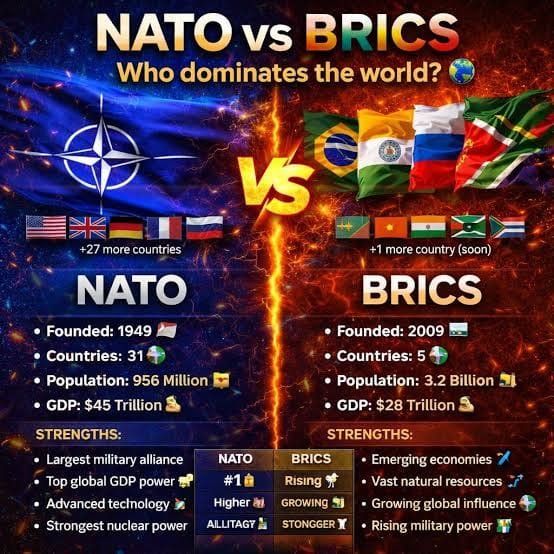
NATO, the North Atlantic Treaty Organization, was created in 1949 as a collective defense alliance. Its 32 members include the United States, United Kingdom, France, Germany, Canada, Italy, Poland and other European and North American nations.
Its biggest advantage is collective military power. NATO members coordinate defense planning, intelligence, military exercises and weapons systems. Most importantly, Article 5 establishes the principle of collective defense: an attack on one member is treated as an attack on all.
BRICS is fundamentally different. It is not a military alliance and does not have a NATO-style collective defense mechanism. Instead, it is a political and economic grouping focused on cooperation among emerging and developing economies.
Military Power: NATO Has the Clear Advantage
NATO vs BRICS
When it comes to military capability, NATO has a significant advantage.
The United States alone possesses enormous air, naval, technological and logistical capabilities. European NATO members also contribute advanced fighter aircraft, naval forces, missile systems, intelligence capabilities and modern defense technology.
BRICS includes major military powers such as China, Russia and India. China has one of the world’s largest armed forces, Russia remains a major nuclear and missile power, and India has significant conventional and nuclear capabilities.
However, BRICS does not operate as a unified military force. Its members do not have a common defense command comparable to NATO.
That makes NATO considerably stronger as an organized military alliance.
Economic Power: The Picture Becomes More
NATO vs BRICS
Complicated
The economic comparison is far more complicated.
NATO includes some of the world’s wealthiest economies, particularly the United States, Germany, the United Kingdom, France, Italy and Canada. The U.S. dollar also remains central to global finance and international trade.
BRICS, however, brings together enormous consumer markets, manufacturing capacity, energy resources and rapidly growing economies. China is a global manufacturing powerhouse, India is one of the world’s fastest-growing major economies, while Russia and other members are important suppliers of energy and commodities.
This gives BRICS considerable influence over global trade, energy markets and supply chains.
Population and Natural Resources
BRICS has another major advantage: scale.
Its members collectively represent a huge portion of the world’s population. The group also includes countries with enormous energy, agricultural and mineral resources.
NATO, by comparison, has a much smaller population but contains highly developed economies with advanced infrastructure, technology and financial systems.
So while BRICS has an advantage in population and natural-resource scale, NATO has a major advantage in high-income economic capacity and technological integration.
The Bigger Battle: Technology, Trade and Influence
NATO vs BRICS
The future competition between NATO-aligned countries and BRICS will not be decided by military power alone.
Artificial intelligence, semiconductors, energy security, critical minerals, space technology, financial systems and global supply chains are becoming increasingly important.
The United States and its European allies maintain major advantages in several advanced technologies and financial institutions. At the same time, China and other BRICS members are investing heavily in technology, infrastructure and alternative international financial arrangements.
This makes the emerging competition much broader than a traditional military rivalry.
Who Is More Powerful?
If the question is military power and coordinated defense, NATO has the stronger position.
If the comparison is population, natural resources and the combined weight of emerging markets, BRICS has enormous potential.
The real story behind NATO vs BRICS is therefore not simply about which group would win a confrontation. It is about the emergence of a more fragmented and competitive international system.
NATO remains the dominant military alliance, while BRICS is becoming an increasingly important economic and geopolitical force. How these two power centers interact could shape global politics, trade and security for decades to come.